Collection of antique orchestrions and player pianos at Orchestria Palm Court restaurant in San Jose

Our Story & Machines

Home of the Self-Playing Violin

Our Story

The Orchestria Palm Court restaurant is located in a rustic restored 1910 brick structure, complete with its original skylights. It strives to emulate the character of restaurants and bars of the early part of the 20th century, which was largely defined by mechanical music equipment. These machines were truly the “high tech” of their time, and efforts to out-engineer and out-market against competitors were every bit as fierce as they are in today’s high-tech industries.

Music of the era — ragtime, jazz, blues, and novelty songs — was nearly always written to be played on a piano. Sheet music provided the general tune, but it could only “come to life” by the skills of the artist playing it. This is why we are fortunate to have transcriptions of actual performing artists of the day — in the form of the piano roll.

The premier recording medium of the period, the perforated paper roll allowed notes and controls punched in the paper to operate the piano by working off vacuum from an electric pump. More importantly, it permitted a skilled arranger to encode the artist’s expression in the music. Thus, the electric piano became a primary source of entertainment before audio amplification was developed.

The name “Orchestria Palm Court” derives from the term “orchestrion” — a high-end version of the electric piano that also operates pipe, percussion, and even string instruments from the same punched paper roll. These were popular as substitutes for small orchestras, and reached their technological pinnacle in the 1920s.

Once amplified radio and jukeboxes became popular, the demand for orchestrions subsided; the stock market crash of 1929 effectively killed off further development. Yet music from these machines remains as entertaining today as it was then.

At the Palm Court, music comes from a variety of musical instruments: piano, pipes, bells, drums, and even a violin take part in making the songs come alive. We also play vintage vocal tracks from the era on our two period jukeboxes.
See the Self-Playing Violin in Action

The Violano-Virtuoso — one of the most amazing mechanical music machines ever made

Our Mechanical Music Machines

Seven antique instruments spanning 1906 to 1935

The Imhof and Mukle Commandant 2 orchestrion, a large wooden cabinet with visible pipes and percussion instruments

Imhof & Mukle “Commandant 2” Orchestrion

Circa 1920

Providing entertainment at the Palm Court courtesy of the David William Allen and William Noble Lee Trusts, the Imhof & Mukle is a fine German instrument originally intended to emulate a small salon orchestra with its sophisticated violin pipe system.

Due to scarceness of music rolls of this type, the machine has been upgraded to a system that accommodates the “O” roll scheme used by Coinola, which greatly enhances the number of instruments that can be played. The piano and violin pipes are now accompanied by a full complement of percussion instruments: bass drum, snare drum, wood block, triangle, and tambourine are all played automatically by the roll.

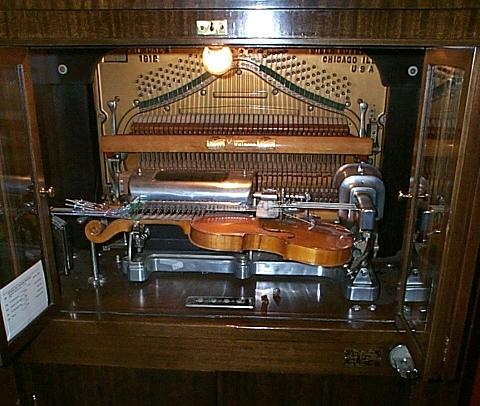
The Violano-Virtuoso, a wooden cabinet housing a real violin played by electromagnetic mechanisms alongside piano keys

Violano-Virtuoso Player Violin

Circa 1925

Mills Novelty Company manufactured what is considered one of the most amazing mechanical music machines ever made — the Violano-Virtuoso. This advanced device plays a real violin together with piano accompaniment using clever electromagnetic techniques. Even the U.S. Patent Office touted the genius of the invention.

While versions of this machine were introduced to the market as early as 1907, the music rolls in the Palm Court collection were produced primarily between the years 1917 and 1933.

Learn more about Mills Novelty Co. →
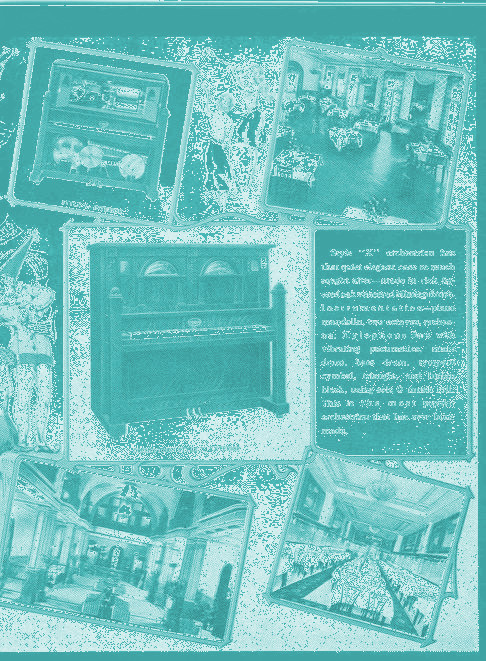
The Coinola X orchestrion with visible piano keys, orchestra bells, and percussion mechanisms

Coinola “X” Orchestrion

Circa 1920

Operators Piano Company produced the Coinola line of electric pianos and orchestrions. Two of the machines seen and heard at the Palm Court use Coinola type “O” music rolls, which provide specific control channels for an incredibly diverse set of instruments. The Palm Court plays music dating from 1913 in this format.

The Coinola “X” model has many instruments to accompany the piano music, with both mandolin effects and two octaves of Deagan orchestra bells that can play a separate tune from the piano melody. Full percussion includes bass drum, snare drum, triangle, and wood block.

Learn more about Coinola →
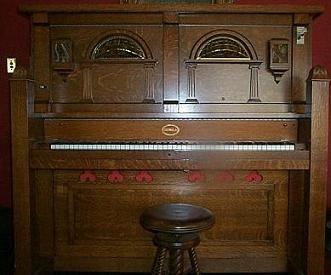
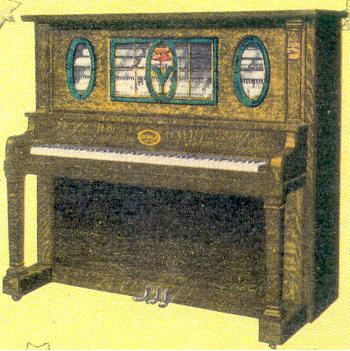
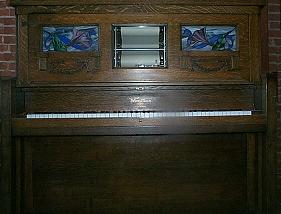
The Coinola A electric piano, a wooden upright piano cabinet with coin slot

Coinola “A” Electric Piano

Circa 1910

Coinola electric piano model “A”, using type “A” rolls, is also on display at the Palm Court. The “A” rolls are of an earlier design used by Seeburg that have limited provisions for additional instrument control. However, the music available for them spans a wider range of years.

The Palm Court plays music dating from 1906 in this format, and the collection includes original rolls dating to as late as the 1940s.

View Coinola cards gallery →
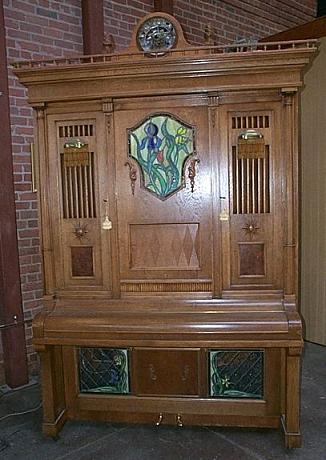
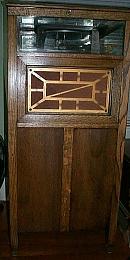
The Wurlitzer Violin Piano, a tall wooden cabinet with visible pipes designed to emulate a violin sound

Wurlitzer Violin Piano

Circa 1916

This Wurlitzer electric piano uses pipes to emulate the sound of a violin that plays along with the piano keys when triggered by perforations in the roll. The effect is more like playing a piano and organ together, but is still interesting.

The type “APP” rolls available for this piano include many of the most popular hits of the day, with early jazz music arranged in an engaging and upbeat style. The Palm Court roll collection covers the period from 1913 to 1935.

The Deca Disc / Ristau jukebox, an early disc record jukebox from 1928

Deca Disc / Ristau Jukebox

1928

Introduced in 1924, the Deca Disc phonograph is one of the earliest acoustic disc record jukeboxes to hit the market. As the name implies, it was originally intended to handle ten discs. However, engineering problems required a re-tooling that limited it to just five records.

The model in use at the Palm Court was a 1928 version produced when Ristau bought out Deca Disc. They converted the machine to electric amplification using a Silver-Marshall three-tube amplifier.

Learn more about the Deca Disc →
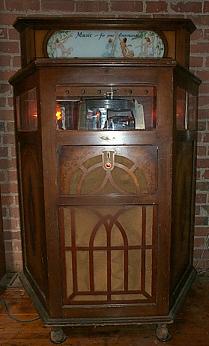
The Electramuse jukebox, a wooden cabinet with a turntable mechanism visible behind glass

Electramuse Jukebox

Circa 1926

The Electramuse jukebox uses a beefed-up redesign of the Deca Disc mechanism, allowing it to handle a full ten records. The Electramuse reproducer was optimized to play the then-new electrically recorded discs (as opposed to acoustically recorded discs).

It contains no amplifier; its reproduction is purely acoustic.

Learn more about the Electramuse →

Our Antique Soda Fountain

Drinks that are made fresh at a soda fountain can taste much different than what you are used to from a bottle or can. At the Palm Court, we’re proud of our soda fountain, and of the person behind the counter skilled at concocting drinks the way they were done 100 years ago.

Many are made with fresh-squeezed fruit juices that you’ll find very refreshing, and a perfect match for fine dining. There’s an art to making one correctly.

See Fountain Menu
The antique soda fountain at Orchestria Palm Court with vintage brass fixtures

Hear the Music

Recordings from the teens and twenties — played the way they were originally heard

Music used to be tuneful — you would hear a great new song, and the melody stood right out. You’d quickly find yourself humming it. Below are a few recordings that were written in the teens and twenties. Some remain as “standards” today, while others are long forgotten. But you’ll find them all entertaining!

Experience It in Person

Twelve intimate tables · Reservations recommended